








DIGITAL THREATS
Managing and mitigating cyber security risk has become an increasingly complex challenge. Government agencies are urging companies to take action to mitigate cyber threats such as domain name and DNS hijacking.
CSC can help
DOMAIN SECURITY INSIGHTS
0%
0%
0%
0%
Read more in our 2023 Domain Security Report.
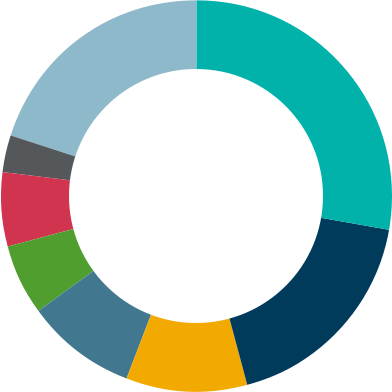
PHISHING
ACTIVITY BY
INDUSTRY
Source: APWG report
0M
detected phishing sites
APWG report
$0B
(2.5%) of world trade in counterfeit and pirated products
Latest OECD study
$0B
in reported cyber crime (49% increase from previous year)
Latest Statisa report
INTRODUCING CSC DOMAINSECSM
We've revolutionized the domain name business. As the world's leading corporate domain name registrar, CSC is the only company in the unique position to offer the most innovative, next generation domain management and security solutions coupled with online brand and fraud protection. DomainSec is a new, comprehensive platform for domain security. Powered by a correlation engine and machine learning technology, it brings together the variety of data sets and blocking networks only available to CSC, enabling threat intelligence based on domain security insights.
DOMAIN MANAGEMENT AND SECURITY
Secure and manage your domain portfolio, DNS, and digital certificates.
BRAND PROTECTION
Monitor, detect, and enforce against the unauthorized use of your brand across all online channels.
FRAUD PROTECTION
Protect against phishing attacks and email fraud.
CUSTOMER TESTIMONIALS
It’s no secret that the stronger your relationships are with your customers, the more likely the business relationship will be win-win. Within a fast-changing digital world, CSC consistently breaks down barriers to help our customers overcome challenges no matter where they are across the world.

Natuzzi endorses CSC
Natuzzi Italia is the world's best known furniture brand, designing sofas, chairs, tables, beds, and more to create harmony throughout the home.

RESOURCES AND NEWS
REPORT

Domain Security Report 2023
As cybersecurity becomes more AI-powered, attacks continue to rise, making domain security an important part of a company’s highest-level cyber risk assessment.
IN THE NEWS

Cybercriminals register .AI domains of trusted brands for malicious activity
CSO Online, October 17, 2023
Third parties are registering brands under the .AI domain to launch phishing attacks or other types of brand abuse.
IN THE NEWS

CSC Report Highlights Cybersecurity Threats .AI Domains Pose
Security Boulevard, October 17, 2023
An analysis published by CSC found 43% of Forbes Global 2000 companies do not have control over their branded artificial intelligence (.AI) domain names that have instead been registered by third parties.